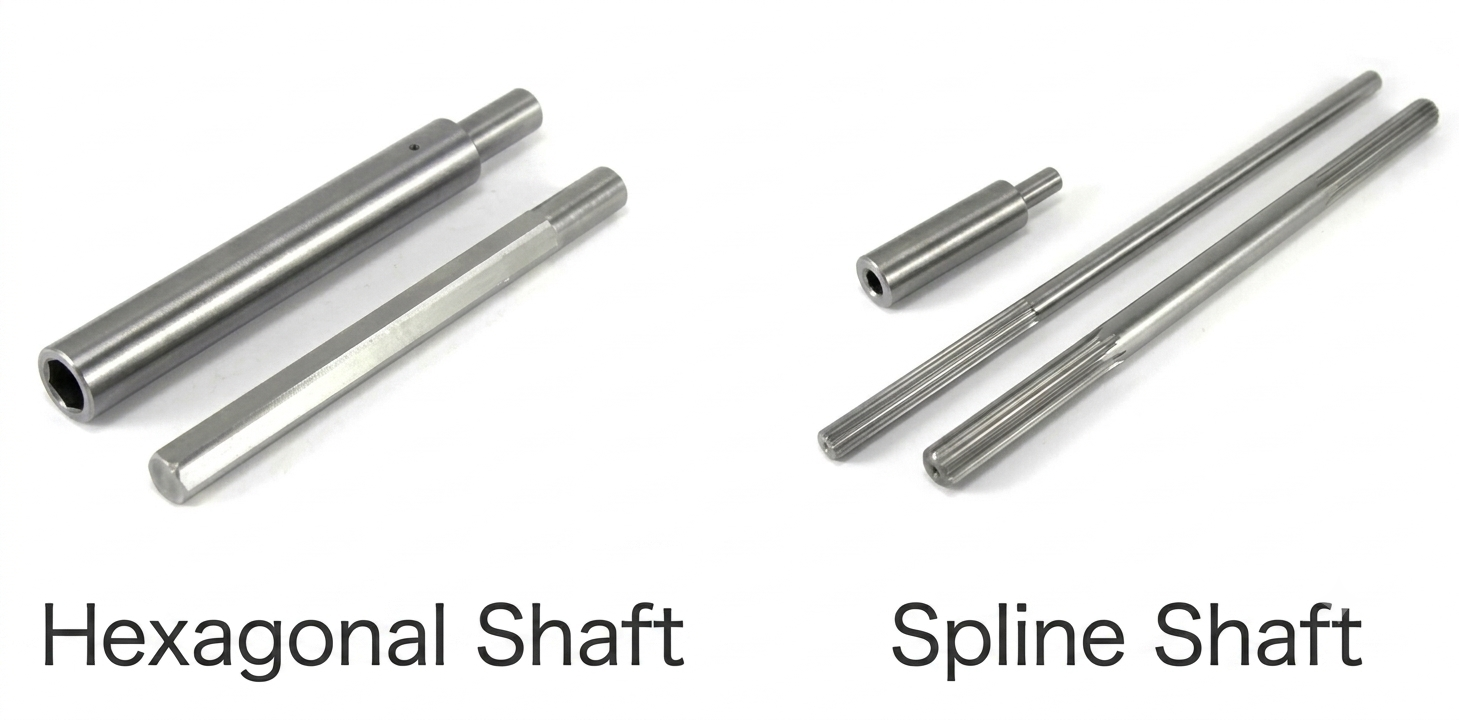



















A joint drives the timing screw, while the extendable/retractable function reflects a user-friendly design.
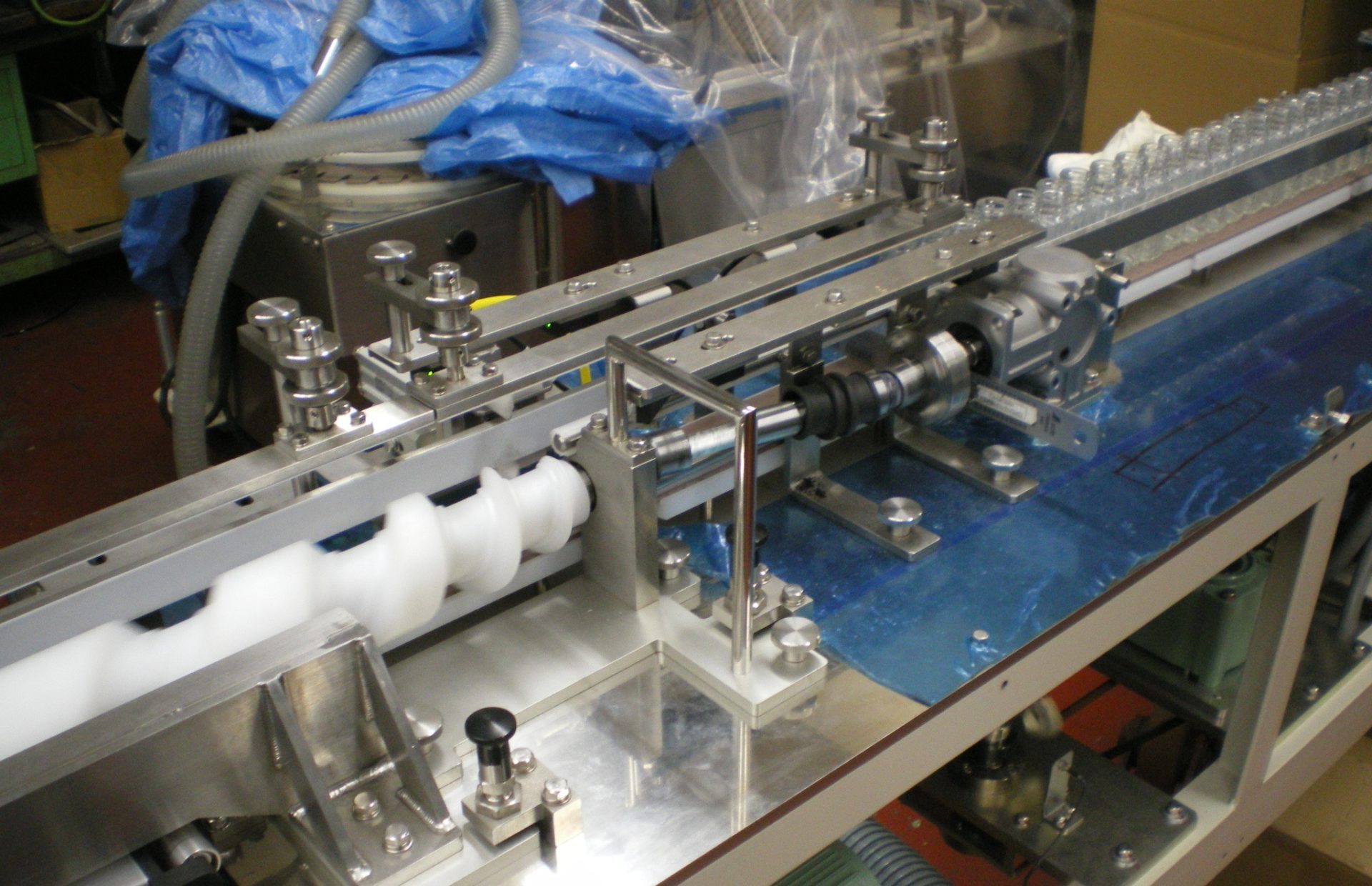
Timing Screw Drive System
This is the configuration of a drive system used in factory automation lines, specifically for the glass bottle transport process.
The setup consists of: Motor → Bearing → Universal Joint → Bearing → Timing Screw.
While it may appear to be a simple combination of parts at first glance,
the design incorporates thoughtful consideration for the workers operating the equipment.
Solving the Challenge of Misalignment (Leveraging Universal Joint Characteristics)
Timing screws are responsible for aligning moving bottles at precise intervals,
so they must be positioned directly above the rail (or guide) through which the products pass.
However, space must be maintained for the bottles to travel along the line,
making it physically impossible to place the drive motor in a straight line directly behind the screw.
Consequently, the motor must be installed with an offset to avoid interfering with the rail.
This inevitably results in misalignment between the shafts (specifically, axial offset and angular misalignment).
To address this, Miyoshi Kikai’s universal joints are employed to flexibly absorb
the misalignment that is structurally unavoidable.
“Telescopic Function” for Efficient Changeovers (User-Centric Design)
On the production floor, “changeovers”—where timing screws are frequently swapped out
to accommodate changes in bottle size—are a common occurrence.
Typically, replacing components connected by a shaft
requires moving the motor or bearings to create sufficient working space.
This task is streamlined by using a shaft-equipped universal joint that combines misalignment compensation with a telescopic function.
By utilizing Miyoshi Kikai’s GX series (which features a hexagonal shaft and a sleeve with a hexagonal bore between the joints),
it is possible to freely adjust the axial length while reliably transmitting rotational force.
A simple, quick compression of the joint allows the screw to be attached or detached without moving any surrounding equipment.
This feature exemplifies a design that prioritizes the needs and convenience of the workers. They are also used in applications requiring minimal angular deviation, specifically to reduce assembly time and facilitate attachment and removal.
Limitless Structural Possibilities Driven by Designer Ingenuity and Consideration
Miyoshi Kikai offers intermediate components such as spline shafts and sleeves (capable of extending and retracting while rotating),
as well as hexagonal shafts and sleeves (which do not extend or retract during rotation).
While there are instances where the telescoping function is utilized to accommodate changes in workpiece height during the manufacturing process,
these designs go beyond mere mechanical functionality; they also incorporate features intended to reduce task times and alleviate the physical burden on operators.