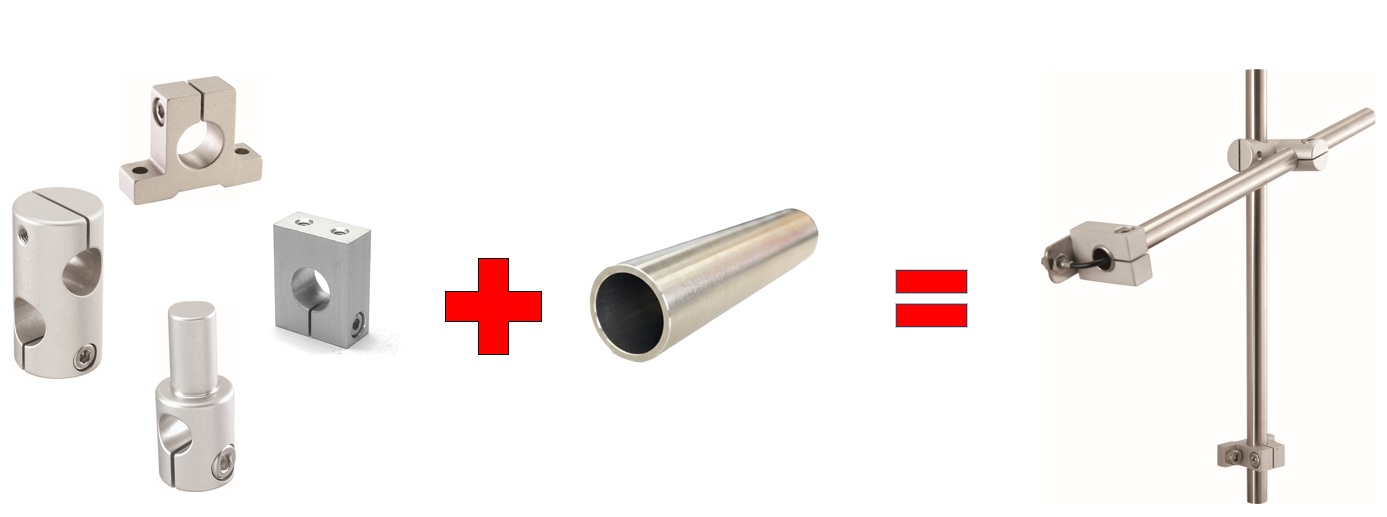



















Recommended for those who want to mount a camera on the top surface!
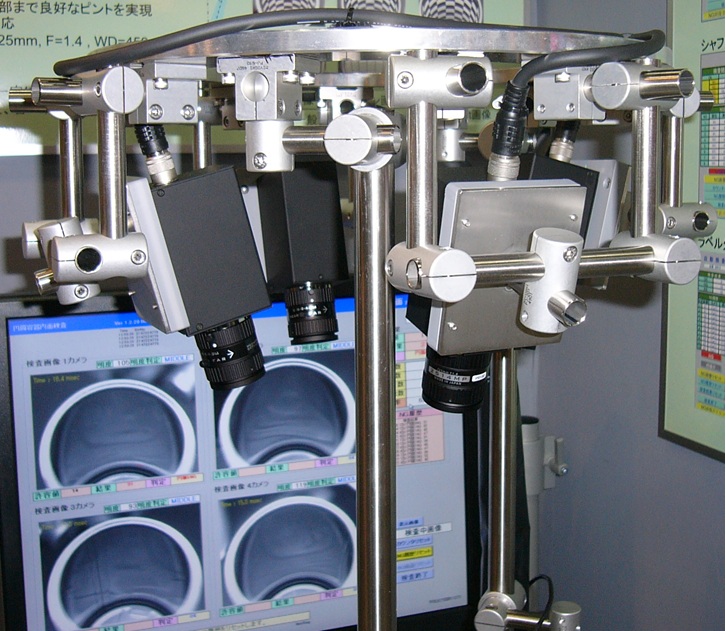
This is Miyoshi Kikai’s “PIJON,” which excels in spatial mounting applications.
Mounting Imaging Equipment
The goal was to suspend a CCD camera from above to inspect the interior of cans or bottles.
However, the client was unsure what to use to mount the camera in mid-air.
Fabricating a custom jig was also a hassle. Miyoshi Kikai’s “PIJON” (Pipe-Joint) system solved these issues.
How the PIJON System Was Used
We constructed the assembly shown in the image above primarily by combining PIJON PJ series (φ13) components with round pipes.
The specific Pijon models used were the PJ200, PJ201, PJ204, PJ610, and LJ200.
(*Note: The camera mounting base and the circular plate at the top were provided by the customer.)
The central pipe serving as the main support is φ19, while the rest of the structure utilizes φ13 piping.
To transition from the φ19 pipe to the φ13 pipes, we used the LJ200—a reducing joint designed to connect φ19 and φ13 pipes.
A φ13 pipe extends from a right-angle cross joint and connects to the PJ204.
The boss section of the PJ204 connects to the hole in the PJ610, securing the assembly to the base of the circular plate.
Why Choose Pijon?
A total of four CCD cameras are mounted on the unit.
When inspecting the interior of containers like cans, simply pointing a camera straight down does not capture the side walls effectively.
To address this, we used four cameras and angled them specifically.
This setup successfully captured images of the interior side walls.
The “Maru-PIJON” (Round PIJON) and round pipes played a key role in adjusting these angles.
Leveraging the versatility inherent in round components, we could position and angle the cameras exactly as needed.
Since the components are secured simply by tightening bolts with a hex key, making repeated fine adjustments is easy.
These advantages made the PIJON system the ideal choice.
What Happens Without Pijon?
Since the size of the products being inspected varies, position adjustments are inevitable.
If the customer were to fabricate the mount themselves instead of using PIJON, they would likely have to rely on welded construction. If you use a welded structure, however, you cannot make on-site adjustments, which could result in having to remake the entire assembly.
That is why “PIJON” is so convenient—it allows for repeated adjustments right at the installation site.
You don’t need to worry about load-bearing capacity, either.
Since it mounts to the top surface, one might worry about a CCD camera falling, but that is not an issue.
Made of aluminum alloy, PIJON features a slit design that firmly clamps and holds the pipe in place.
It can securely hold a CCD camera weighing around 3 kg.
Pijon offers infinite possibilities.
With Pijon, you can bring the unique jigs you’ve envisioned to life in open space.
If you are struggling with mounting components or adding parts later on, Miyoshi Kikai’s PIJON is well worth a try.