


















Eliminate vacuum errors on injection molding take-out robots! Achieve weight reduction and on-site customization with aluminum Pijon components.
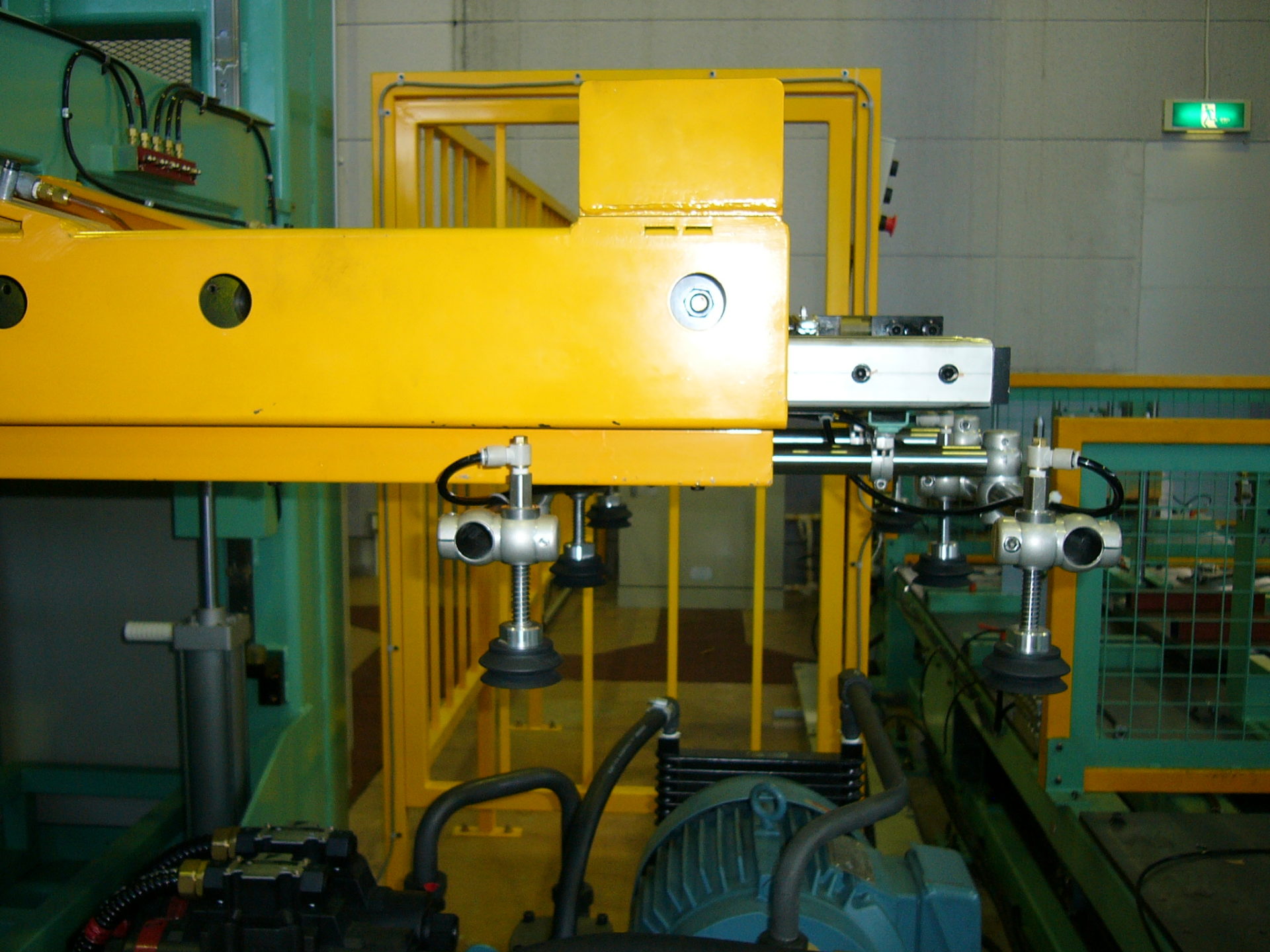
Mounting vacuum pads using Pijon units.
Boost the Efficiency of Injection Molding
Take-Out Robots! Vacuum Suction Systems
As production floors become increasingly automated, Miyoshi Kikai’s “Pijon” system
has become an indispensable component for robot hands and transfer jigs.
Here, we introduce an example where vacuum pads were mounted
onto the frame of an injection molding take-out robot.
On-Site Challenge: The Dilemma of
“Weight” and “Lack of Adjustability” in Welded Structures
Conventional vacuum mounting jigs were typically manufactured using welded structures.
However, this approach presented two major challenges that troubled production teams:
① Load caused by increased equipment weight
A heavy frame places excessive strain on the take-out robot’s motors and drive mechanisms.
This results in slower operating speeds and accelerated component wear.
② Difficulty in fine-tuning angles
To prevent suction failures, the vacuum pad must make contact perpendicular to the workpiece surface.
Especially with curved products, a misalignment of even a few degrees can lead to critical suction failure.
Consequently, conventional welded structures—which cannot be adjusted once fixed—
failed to provide the flexibility needed for on-site angle tweaks or adjustments to subtle changes in product shape.
“Dramatic Weight Reduction” and “Reduced Strain” with Aluminum Pijon
This challenge was solved by combining stainless steel piping with lightweight aluminum alloy Pijon components.
Replacing heavy welded structures with this system achieved a dramatically lighter overall jig.
This supports agile robot movement,
enabling both faster transfer speeds and extended equipment lifespan by reducing the load on the drive system.
This significant weight reduction has been highly praised on-site,
with operators noting that the take-out robot’s movement has become much smoother.
“Precise Angle Adjustment” to Handle Curved Workpieces
The true strength of the Pijon system lies in its ability to achieve flexible positioning
by rotating components around a round pipe axis.
Even when arranging multiple pads side-by-side—as shown in the example photo—
you can fine-tune the angle of each pad in one-degree increments.
This flexibility allows you to pinpoint the optimal suction position through on-site adjustment
to match the product’s complex curved surfaces;
it prevents line stoppages caused by suction errors and directly boosts production efficiency.
**Drastically reduce management costs and storage space through “universal tooling”**
One key reason to choose Pijon is its capability for “universal tooling.”
For production sites handling a wide variety of workpieces,
maintaining dedicated jigs for each product type imposes a heavy burden in terms of both cost and management.
However, because Pijon allows for free adjustment of position and angle,
a single jig can be transformed into a “universal jig” capable of handling diverse workpieces
with just minor fine-tuning.
This drastically reduces the number of jigs required and saves on storage space,
while also cutting total costs—from initial fabrication to post-installation management.
**”Robust holding power” capable of withstanding a 30kg load**
Its unique “slit-clamping structure” grips the pipe firmly across its entire surface.
Even when subjected to intense inertial forces from sudden stops or rapid turns during transport,
it maintains a rock-solid hold—staying secure even under heavy loads of around 30kg.
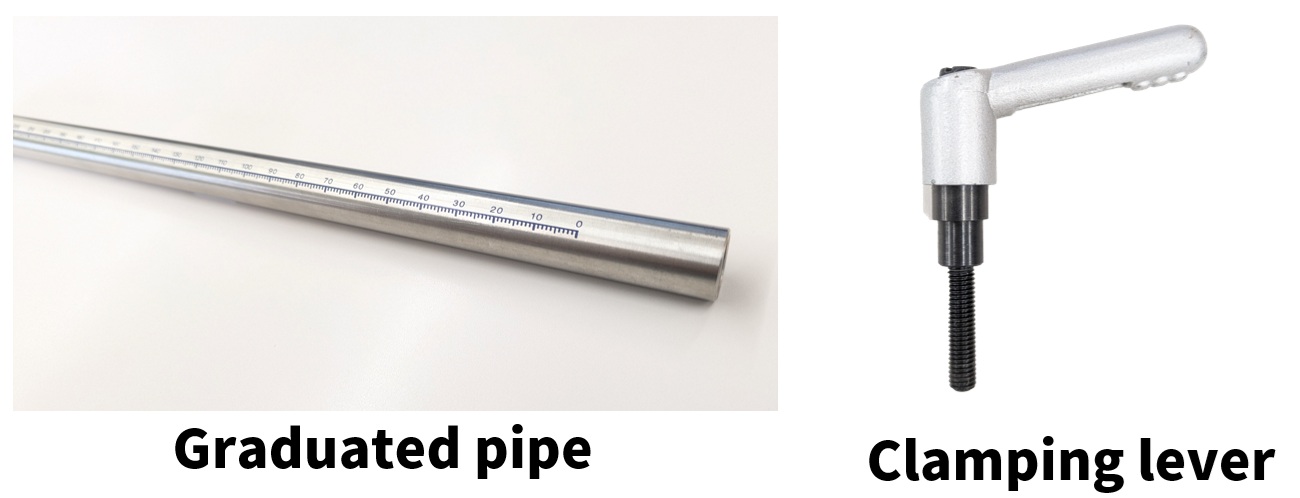
Furthermore, by combining options such as “scaled pipes” (for managing settings via numerical values)
and “clamp levers” (for tool-free adjustment),
you can drastically reduce setup times during maintenance and product changeovers.
**Pursuing a “system-based approach”
to revolutionize the production floor**
Miyoshi Kikai’s “Pijon” is far more than a simple fixture.
It is a “multi-purpose system component” that allows users to quickly turn creative ideas into reality;
by combining various parts like pieces of a puzzle,
you can create ideal functions—unobtainable in off-the-shelf products—right out of thin air.
This outstanding “system-based design” is precisely why Pijon continues to be the choice for so many worksites.
With the core attributes of being “lightweight, versatile, and stable,
” Pijon eliminates the need for custom fabrication and enables smooth on-site adjustments,
thereby contributing to improved daily work environments and enhanced productivity.